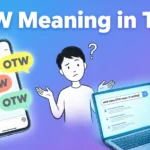
OTW meaning in text is one of the most commonly searched slang terms used in online chats, social media, and gaming conversations.
With the rise of fast digital communication, people prefer short forms instead of typing full sentences. That’s where slang like OTW becomes popular.
If you’ve seen someone typing “OTW” in WhatsApp, Instagram, Snapchat, or gaming chats and felt confused, you’re not alone.
OTW is a simple abbreviation, but its meaning depends on the context of the conversation. It is widely used in casual messaging to save time and respond quickly.
Quick Answer:
OTW means “On The Way” in text messages, used when someone is traveling or heading toward a destination.
What does OTW mean in text?
OTW in text stands for “On The Way.” It is used when someone is moving toward a place or is about to reach somewhere soon.
For example:
- If a friend asks, “Where are you?”
You can reply: “OTW”
This means you are currently traveling or coming to meet them.
Full form / definition of OTW slang
- OTW Full Form: On The Way
- Meaning: The person is traveling or going to a destination
- Type: Internet slang / chat abbreviation
It is mainly used in informal communication and is very popular among teenagers and young adults.
Meaning in different contexts
The meaning of OTW stays mostly the same, but it can slightly change depending on the situation:
1. Travel context
- “I’m OTW to school.”
👉 You are physically going to school.
2. Meeting friends
- “OTW bro, see you in 10 minutes.”
👉 You are heading to meet your friend.
3. Online gaming
- “OTW to join the match.”
👉 You are joining or entering the game soon.
4. Work or events
- “OTW to office.”
👉 You are commuting to work.
Is OTW rude, offensive, or neutral?
OTW is completely neutral.
It is:
- Not rude
- Not offensive
- Not formal
It is simply a shorthand used in casual communication. However, it should not be used in professional emails or formal writing.
Where is OTW commonly used?
OTW is widely used across multiple platforms:
- WhatsApp chats
- Instagram DMs
- Snapchat messages
- Facebook Messenger
- Online gaming chats
- SMS texting
It is especially common in fast conversations where people want to respond quickly.
Real-life examples of OTW usage
Friendly conversation
A: “Are you coming to the café?”
B: “Yes, OTW 😊”
Casual chat
A: “Where are you?”
B: “OTW, stuck in traffic.”
Argumentative tone
A: “You’re always late!”
B: “Relax, I’m OTW already.”
Gaming context
Player 1: “Start the match!”
Player 2: “OTW to lobby.”
Origin and background of OTW slang
OTW became popular with the rise of SMS texting in the early 2000s. As mobile messaging grew, users started shortening common phrases to save time and characters.
“On The Way” was frequently used in daily conversations, so it naturally turned into OTW. Later, with apps like WhatsApp, Snapchat, and Instagram, the slang became even more widespread.
Today, OTW is part of modern internet slang vocabulary used globally.
Comparison with similar slang terms
Here is a quick comparison of OTW with other common texting abbreviations:
| Slang | Full Form | Meaning |
|---|---|---|
| OTW | On The Way | Heading to a place |
| BRB | Be Right Back | Temporarily away |
| TTYL | Talk To You Later | Ending conversation for now |
| ETA | Estimated Time of Arrival | Expected arrival time |
| OMW | On My Way | Similar to OTW, more personal |
👉 OTW and OMW are often used interchangeably, but OMW is slightly more personal.
When to avoid using OTW
Although OTW is very common, there are situations where you should avoid using it:
- Formal emails
- Job applications
- Professional communication
- Academic writing
- Official documents
In these cases, always use the full phrase “On the way” instead of slang.
Why people use OTW in communication
People prefer OTW because:
- It saves time while typing
- It is easy to understand
- It makes conversations faster
- It fits modern texting culture
- It is widely recognized globally
In short, OTW is part of digital convenience language.
Impact of using slang like OTW in communication
Using slang like OTW has both positive and neutral impacts:
Positive impact:
- Speeds up communication
- Makes texting more natural
- Helps informal conversations feel friendly
Neutral impact:
- Can be confusing for older people or non-English speakers
- Not suitable for professional use
Overall, it improves casual digital communication but should be used in the right context.
Is OTW safe for social media?
Yes, OTW is completely safe for social media.
It is:
- Non-toxic
- Non-offensive
- Widely accepted
You can safely use it on platforms like Instagram, Snapchat, Facebook, and Twitter without any issues.
More real-life examples of OTW
Friendly tone
“Hey, OTW now. Meet you soon!”
Casual update
“OTW, traffic is heavy today.”
Emergency message
“OTW, will be there in 5 minutes!”
Gaming chat
“OTW to assist you, stay alive!”
FAQs about OTW meaning in text
1. What does OTW stand for in chat?
OTW stands for “On The Way,” meaning someone is heading to a destination.
2. Is OTW and OMW the same?
Yes, both mean “On My Way” or “On The Way,” but OMW is slightly more personal.
3. Can I use OTW in formal writing?
No, OTW is only suitable for informal chats and messages.
4. Is OTW slang or abbreviation?
OTW is an internet slang abbreviation used in texting.
5. Where is OTW mostly used?
It is commonly used in WhatsApp, Snapchat, Instagram, and gaming chats.
6. Is OTW still popular in 2026?
Yes, OTW is still widely used in digital communication and remains popular.
Conclusion
OTW meaning in text is simple and widely used—it stands for “On The Way.” It is a popular slang term used in everyday digital communication to quickly inform someone that you are heading to a place. Whether you are chatting with friends, gaming, or updating someone about your travel status, OTW helps you communicate faster and more efficiently.
However, it is important to use OTW only in informal settings. In professional or formal communication, always write the full phrase “On the way.” Understanding slang like OTW helps you stay updated with modern internet language and improves your digital communication skills.

I’m Lila Grace, a passionate writer who finds joy in crafting thoughtful wishes and uplifting messages. I love turning simple words into meaningful expressions that touch hearts. My goal is to help people celebrate life’s beautiful moments through genuine writing. Each article I write reflects my belief in kindness, connection, and happiness.