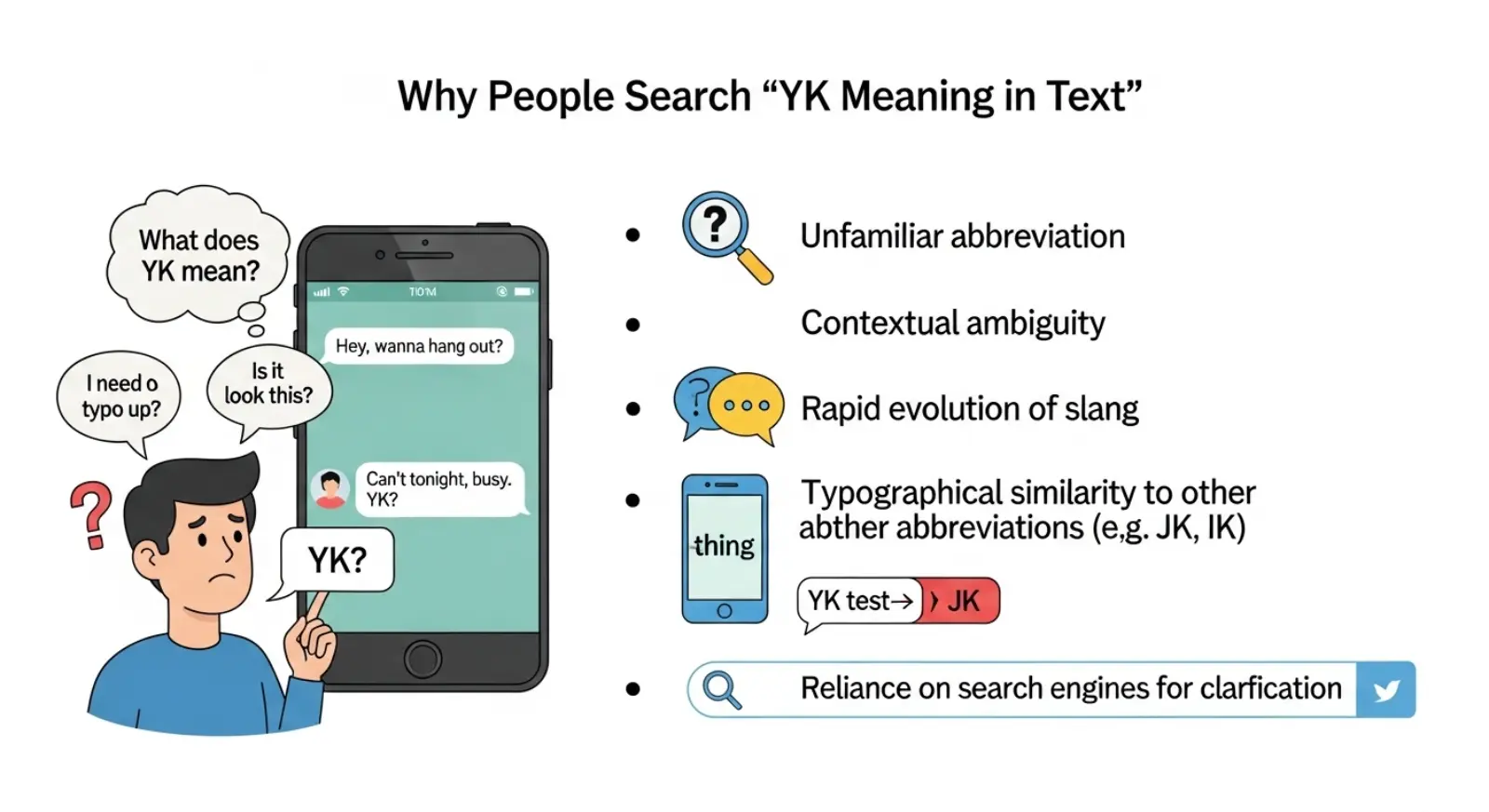
YK meaning in text is something many people search when they come across this short slang in chats, social media, or online conversations.
With texting becoming faster and more casual, abbreviations like “YK” help people communicate quickly without typing long sentences. But if you’re new to internet slang, it can feel confusing or unclear at first.
Understanding these short forms is important, especially if you want to stay updated with modern communication trends or avoid misunderstandings in chats.
If you’re texting friends, scrolling through comments, or gaming online, knowing what “YK” means can help you respond more confidently.
⚡ Quick Answer:
YK stands for “You Know.” It’s used in conversations to refer to something the other person already understands or is expected to relate to.
What does YK mean in text?
The YK meaning in text is simple: it means “You Know.” People use it to shorten conversations and make texting quicker.
YK full form
- YK = You Know
YK meaning slang
In slang usage, “YK” acts as a conversational filler or a way to connect with the listener, similar to saying “you understand” or “you get it.”
Meaning in Different Contexts
The meaning of “YK” can slightly change depending on how it’s used:
1. Casual Conversations
Used to make speech sound natural or relatable.
Example: “That movie was amazing, YK?”
2. Explaining Something
Used when you assume the other person already understands.
Example: “It’s just one of those days, YK.”
3. Emotional Expression
Adds a personal or emotional touch.
Example: “I miss those old times, YK.”
Is it rude, offensive, or neutral?
“YK” is generally neutral and harmless.
- ✅ Not rude
- ✅ Not offensive
- ✅ Safe in casual chats
However, overusing it might make your message feel lazy or unclear, especially in formal communication.
Where is it commonly used?
You’ll mostly see “YK” in informal digital communication:
- Text messages (SMS, WhatsApp)
- Social media (Instagram, Facebook, TikTok comments)
- Online gaming chats
- Casual conversations between friends
It is rarely used in professional emails or formal writing.
Real-life examples of usage
Here are some natural ways people use “YK” in daily conversations:
- “I was just tired, YK?”
- “It’s kind of complicated, YK.”
- “That vibe was different, YK what I mean?”
- “You just had to be there, YK.”
Origin and background of the slang
The slang “YK” comes from the phrase “You Know,” which has been used in spoken English for centuries. As texting and internet culture evolved, people began shortening commonly used phrases to save time.
“YK” became popular with:
- The rise of SMS texting (limited characters)
- Social media platforms
- Youth and internet culture
It’s part of a larger trend of abbreviations like:
- “IDK” (I don’t know)
- “TBH” (to be honest)
- “IMO” (in my opinion)
Comparison with similar slang
Here’s a quick comparison of “YK” with similar texting slang:
| Slang | Full Form | Meaning | Usage Tone |
|---|---|---|---|
| YK | You Know | Referring to shared understanding | Casual |
| IDK | I Don’t Know | Expressing uncertainty | Casual |
| TBH | To Be Honest | Sharing honest opinion | Casual |
| IMO | In My Opinion | Giving personal view | Neutral |
| FYI | For Your Information | Informing someone | Slightly formal |
When to use and avoid using it
✅ When to use “YK”
- Chatting with friends
- Casual texting
- Social media conversations
- Informal discussions
❌ When to avoid “YK”
- Professional emails
- Academic writing
- Job applications
- Formal communication
Using it in the wrong context may seem unprofessional.
Polite alternatives (if needed)
If you want a more formal or clear way to say “YK,” here are some alternatives:
- “As you know”
- “You may understand”
- “As you’re aware”
- “You understand”
These are better suited for professional settings.
Why people use this slang
People use “YK” for several reasons:
- ⏱️ Saves time while typing
- 💬 Makes conversations feel natural
- 🤝 Builds connection and relatability
- 📱 Fits casual digital communication style
It mimics real-life speech patterns, making texts feel more human.
Impact of using slang in communication
Slang like “YK” can have both positive and negative effects:
Positive impact
- Makes conversations friendly
- Speeds up communication
- Helps express tone casually
Negative impact
- Can confuse new users
- May seem unprofessional
- Overuse can reduce clarity
Balance is key when using slang.
Is it safe for social media?
Yes, “YK” is completely safe for social media.
- No offensive meaning
- No hidden risks
- Widely accepted in casual communication
Just make sure your audience understands it.
Examples in Different Contexts
Friendly
- “That place was amazing, YK!”
Casual
- “I just felt weird about it, YK.”
Argumentative
- “I already told you, YK how this works!”
Gaming / Social Media
- “That match was intense, YK what I mean?”
FAQs about YK meaning in text
1. What does YK stand for in texting?
YK stands for “You Know.”
2. Is YK commonly used in chats?
Yes, it is widely used in casual texting and social media.
3. Can YK have different meanings?
Mostly no. It consistently means “You Know,” though context may slightly change tone.
4. Is YK formal or informal?
It is informal and should not be used in professional writing.
5. Is YK the same as “you know what I mean”?
Yes, it can sometimes imply that, especially in extended forms like “YK what I mean.”
6. Should I use YK in emails?
No, it’s better to use full phrases in emails for clarity and professionalism.
Conclusion
Understanding the YK meaning in text is simple once you know it stands for “You Know.” It’s a casual slang term used to make conversations feel more natural and relatable. While it’s perfect for chatting with friends or posting on social media, it’s best avoided in formal situations.
Like all slang, the key to using “YK” effectively is context. Use it where it fits naturally, and switch to more formal language when needed. This way, your communication stays clear, appropriate, and engaging.

I’m Lila Grace, a passionate writer who finds joy in crafting thoughtful wishes and uplifting messages. I love turning simple words into meaningful expressions that touch hearts. My goal is to help people celebrate life’s beautiful moments through genuine writing. Each article I write reflects my belief in kindness, connection, and happiness.