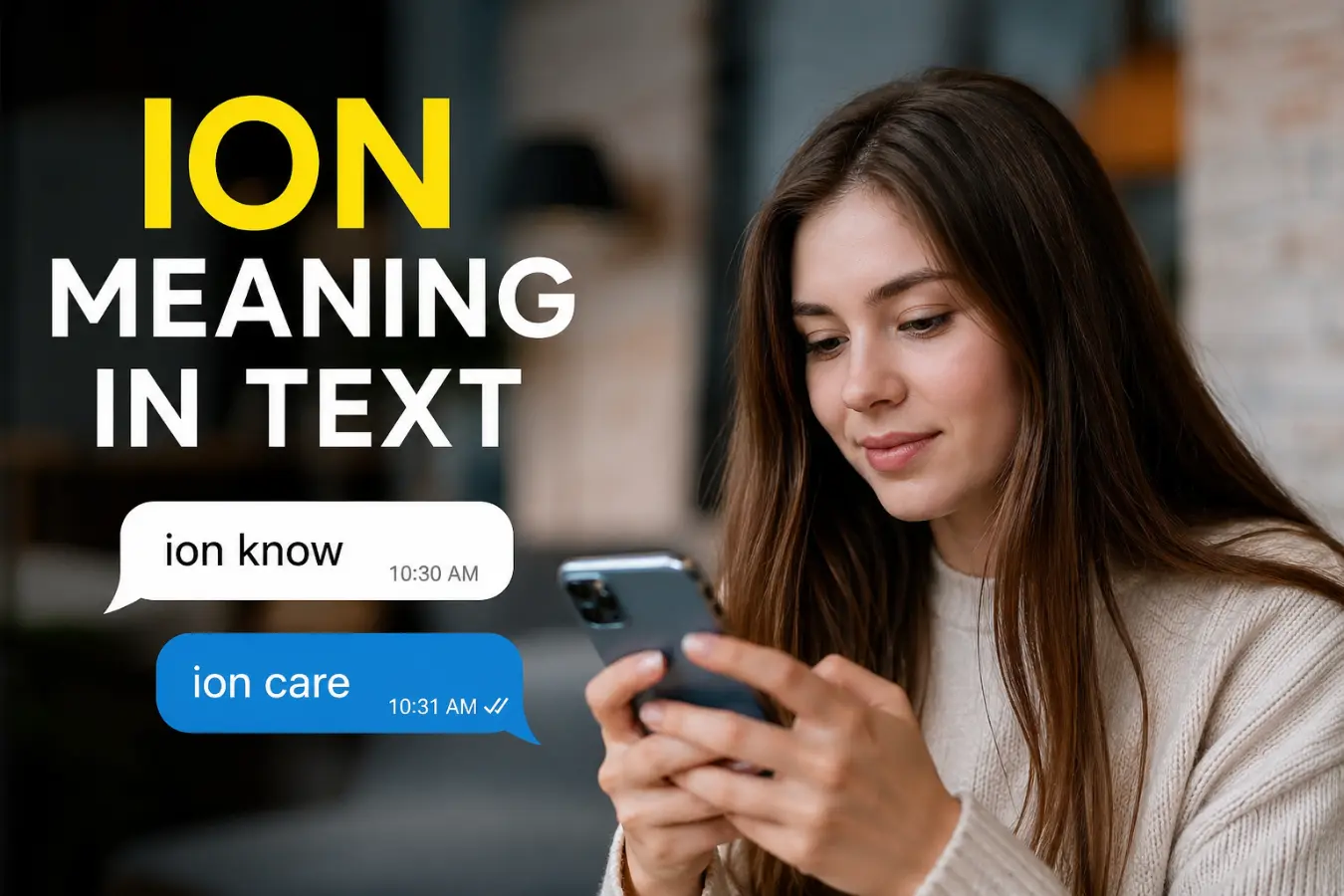
ion meaning in text is one of those slang terms that often confuses people when they see it in chats, TikTok comments, or social media posts.
At first glance, it looks like a science word related to chemistry, but in online conversations, it has a completely different meaning.
Many users search for this term because internet slang keeps evolving, and abbreviations like “ion” can be hard to understand without context.
In modern texting culture, especially on platforms like TikTok, Snapchat, and Twitter (X), people prefer short and fast expressions.
That’s where slang like “ion” becomes popular. It helps users type quickly while still expressing full thoughts.
Quick Answer:
“ION” in text slang means “I don’t” and is commonly used in informal online conversations instead of typing the full phrase.
What does ION Meaning in Text Mean?
In texting slang, “ion” is a shortened, phonetic way of writing “I don’t.” It is widely used in casual online communication, especially in American internet slang and African American Vernacular English (AAVE)-influenced digital speech.
For example:
- “ion know” = “I don’t know”
- “ion care” = “I don’t care”
- “ion want that” = “I don’t want that”
This slang is not grammatically correct in formal English, but it is popular in informal digital conversations where speed and style matter more than grammar rules.
Full form / definition of ION slang
The simple breakdown of ion meaning in text is:
- ION = I don’t
It is not related to scientific ions (charged particles in chemistry). Instead, it is a phonetic abbreviation, meaning people type it the way it sounds when spoken quickly.
So, whenever you see “ION” in chat, just replace it mentally with “I don’t.”
Meaning in different contexts
1. Casual chats
In everyday texting between friends, “ion” is used to sound relaxed and natural.
Example:
- “ION feel like going out today.”
2. Social media posts
On platforms like TikTok, Instagram, or X, users use “ION” to match trending slang style.
Example:
- “ION trust nobody fr.”
3. Gaming chats
Gamers often use it to type faster during gameplay.
Example:
- “ION have ammo left, help!”
Is “ION” rude, offensive, or neutral?
The slang “ION” is completely neutral. It is not offensive or disrespectful by itself. However, the tone of the sentence matters.
For example:
- Neutral: “ion know what happened.”
- Slightly rude (depending on tone): “ion care about that.”
So, the word itself is harmless, but the meaning depends on context.
Where is “ION” commonly used?
The slang ION meaning in text is most commonly found in:
- TikTok comments and captions
- Snapchat chats
- Instagram DMs
- Twitter (X) posts
- Gaming chats (Discord, PUBG, etc.)
It is mainly used by teenagers and young adults who prefer fast, expressive digital communication.
Real-life usage examples
Here are some real-life style examples showing how “ION” is used:
- “ION wanna go to school today 😩”
- “ION even know what to say anymore.”
- “ION trust that situation.”
- “ION got time for drama.”
- “ION think that’s a good idea.”
These examples show how flexible and widely used the slang is in different emotional situations.
Origin and background of “ION”
The origin of ION meaning in text comes from spoken English, especially fast and casual speech patterns.
Key points about its origin:
- It comes from the contraction of “I don’t”
- It is influenced by spoken slang and internet culture
- Became popular through social media platforms like TikTok and Vine
- Spread widely among younger internet users for quick communication
Over time, it became a standard piece of internet slang, especially in informal digital writing.
Comparison with similar slang terms
| Slang | Meaning | Usage |
|---|---|---|
| ion | I don’t | Casual internet slang |
| idk | I don’t know | More widely understood |
| dunno | I don’t know | Informal spoken slang |
| ain’t | am not / is not / are not | General informal grammar |
| don’t | do not | Standard English contraction |
While “idk” is more universally recognized, “ION” is more stylistic and casual, often used in specific online communities.
When to avoid and when to use “ION”
Use it when its fit with:
- Talking with friends online
- Casual social media posts
- Gaming chats
- Meme culture or humor content
When to avoid it:
- Formal emails
- Academic writing
- Job applications
- Professional communication
Using slang in formal situations can make your message look unprofessional or unclear.
Polite alternatives to “ION”
If you want to sound more formal or clear, you can replace “ion” with:
- I don’t
- I do not
- I am not sure
- I don’t think so
These alternatives are better for professional or respectful communication.
Why people use “ION” in text
There are several reasons why this slang became popular:
- Speed: Faster typing in chats
- Trendy style: Fits modern internet culture
- Casual tone: Makes conversations feel relaxed
- Social media influence: Popularized by creators and memes
- Identity expression: Helps users fit into online communities
Slang like “ion” is part of how digital language keeps evolving.
Impact of slang like “ION” on communication
The use of ION meaning in text shows how language changes in the digital age. While it improves speed and creativity, it also has some effects:
Positive impacts:
- Makes conversations more expressive
- Builds online community identity
- Encourages creative language use
Negative impacts:
- Can confuse new internet users
- Not suitable for formal communication
- May affect grammar habits if overused
Overall, it plays an important role in modern digital communication.
Is “ION” safe for social media?
Yes, “ION” is completely safe to use on social media. It does not contain any harmful or inappropriate meaning. However, users should always be mindful of context and audience.
For example:
- Safe: “ion know what’s happening 😂”
- Not ideal in formal posts or announcements
Examples Section (Different tones)
Friendly tone
- “ION know why you’re laughing but I’m here for it 😂”
Casual tone
- “ION feel like cooking today, let’s order food.”
Argumentative tone
- “ION agree with your point at all.”
Gaming / online chat
- “ION have enough health, cover me!”
These examples show how flexible the slang is across different situations.
FAQs about ION meaning in text
1. What does ION mean in texting?
It means “I don’t” in informal online conversations.
2. Is ION a real English word?
Yes, but in science it refers to charged particles. In texting, it is slang.
3. Is ION slang or grammar mistake?
It is slang, not standard grammar.
4. Can I use ION in formal writing?
No, it should only be used in casual conversations.
5. What is ION full form in chat?
The full form is “I don’t.”
6. Why do people use ION instead of I don’t?
Because it is faster, trendier, and fits informal internet culture.
Conclusion
The ION meaning in text is simple once you understand its slang usage. It stands for “I don’t” and is widely used in informal online communication across social media platforms, gaming chats, and casual messaging. While it is not suitable for formal writing, it plays an important role in modern internet language by making conversations faster and more expressive.
Understanding slang like “ION” helps you stay updated with digital communication trends and avoid confusion when browsing social media. Always remember: context matters, so use it wisely depending on the situation.

I’m Lila Grace, a passionate writer who finds joy in crafting thoughtful wishes and uplifting messages. I love turning simple words into meaningful expressions that touch hearts. My goal is to help people celebrate life’s beautiful moments through genuine writing. Each article I write reflects my belief in kindness, connection, and happiness.